















Knowledge Management
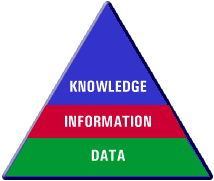
Knowledge is the ability to turn information and data into effective action. Knowledge Management is the process of collecting, organizing, and disseminating knowledge. Knowledge Management (KM) packages the right content and delivers it to the right people at the right time, enabling them to contribute to achieving business objectives. The goal of KM is to allow members of an organization to systematically exploit the group's body of knowledge. More specifically KM will:
- Capture and reuse internal knowledge, best practices, and previous solutions to improve our products and services.
- Provide access of relevant external data (competitor, market, regulatory).
- Allow us to move knowledge from a "tacit" state to a more accessible "explicit" state.
- Provide access to people with the "know-how" and "experience".
- Enable learning through networking and knowledge exchange (to supplement class room learnings).
Why Do it Now?
AFG's decentralized and entrepreneurial organizational model requires "duplicated" functions across the organization. There is a large opportunity to improve effectiveness, better share internal best practices and incorporate business intelligence in order to create value. Some examples include:
- Regulatory Requirements: By 2005, the SEC is expected to require disclosure of Intangibles Assets (i.e. internally generated intangible assets, R&D, employee retention rates, market size and share, customer sat, etc.) in support of our "New Economy" allowing investors and creditors to better evaluate entities and compare them with one another. KM and Communities of Practice will allow us to prepare by categorizing, valuating and qualifying some of these intangibles.
- Best Practices: A successful practice in one business unit could save time and/or money if it were used in others. Companies save millions by leveraging the knowledge of their best performers and apply it to similar situations.
- Efficiencies: It is difficult to distribute, or receive, information quickly from remote locations.
- Corporate amnesia: lessons learned once, are learned again, problems solved once, are solved again.
- Competitive Knowledge Sharing: The competition makes a move, and we should have known sooner, "actually we did, we just didn't share it!"
- Knowledge Retention: By retaining knowledge as organizations downsize or restructure, organizations can save costly mistakes or 'reinventing the wheel'
 |
- Information Overload: We have an increasing demand for information and business intelligence. But is the correct information available at the correct time?
Supporting Functionality
- Communities of Practice: CoP's are informal groups of people joined by a common interest, theme or affiliation. CoP's are not social groups, the basic objective of members is to learn and exchange what they know.
- Portal(s): web based centers for people to find important and relevant information, and links to other sources of information. They provide an organized and structured presentation of information from a variety of sources.
- Search Engines: our access to information continues to expand however, locating 'relevant' information has become increasingly difficult. Search Engines help to locate the appropriate information we are seeking.
- Document Library: A repository of explicit knowledge, experience and tools in the form of documents.
- Collaboration: replication of the efficient sharing, learning, and creating of knowledge that occurs in workgroups (e.g. F2F meetings, instant messaging, whiteboards, audio/video conference, threaded discussions, application sharing, document library).
- Expertise Location: ability to find an ëexpertí to help solve a problem or provide critical knowledge and insight to make decisions. Can provide everyone in an organization a wide and detailed network where questions find answers, talent is identified, recognized and leveraged.
Other Financial Services Companies Doing KM and CoP's
These companies are either in the process of implementing KM initiatives, or have already implemented them:
|
AIG |
Allianz Life |
|
Bank One |
California Casualty |
|
CNA Insurance |
Clarica Insurance Co. |
|
Commonwealth Investment Management |
Dun & Bradstreet |
|
Fannie Mae Foundation |
FM Global |
|
First Union National Bank |
Inter-American Development Bank |
|
MDS Capital |
Merrill Lynch |
|
Mitsui |
Pacific Life |
|
PartnerRe Insurance |
Progressive Financial Strategies |
|
RLI Insurance |
Robertson Stephens |
|
Skandia Insurance Co. |
Stockamp & Associates |
|
Swiss Re |
The Hartford Financial |
|
The St. Paul Co.ís |
Thomas Weisel Partners |
|
Travelex Global Payments |
Universal Underwriters |
|
XL Global |
e |


